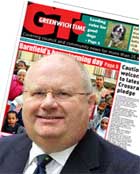
I was airbrushed out of Greenwich Time, claims councillor
July 29, 2010 by Rob Powell
A Conservative councillor has told a council meeting that she was airbrushed out of an edition of the controversial weekly council newspaper, Greenwich Time.
The claim was made by councillor Eileen Glover during a debate at Wednesday night’s full meeting of the council at Woolwich Town Hall.
The councillor for the Eltham South ward told the meeting that she had ensured she was in all the photos taken by Greenwich Time at an event in her ward attended by the Council Leader but by the time it went to print, she had been “airbrushed out”.
She was only able to make an appearance in a later edition by changing her hair so that she was unrecognisable to the Leader of the Council, she said.
The debate over Greenwich Time was prompted after Greenwich Conservatives put forward a motion calling for weekly production of the newspaper to be ended.
Cllr Nigel Fletcher (Conservative, Eltham North) questioned whether the newspaper offered value for money and asked if it could really be considered a “front line service”. He expressed his doubts over the impartiality of the publication before mocking the content in this week’s edition.
“Is it really a core function of this council to provide, for example, a review of Toy Story 3? Do we really have a duty to inform our residents … that Prince’s new album is his most ’soulless yet’?”, he asked. He said ending the weekly printing of Greenwich Time would be an “easy cut”.
Cllr Maureen O’Mara (Labour, Greenwich West) commented that Greenwich Time’s council property pages were “very important” to residents who wanted to move, describing it as providing an “essential service” for those that couldn’t or wouldn’t get the information online.
Cllr Dermot Poston (Conservative, Eltham North) told colleagues that he regarded it as a “political newspaper” and that he “bitterly resents” it. He said the ruling party have “lost any sense of fairness and democracy”.
Cllr Matt Clare (Conservative, Eltham South) used his maiden speech at a full council meeting to say how he would frequently see “No Greenwich Time” notices whilst going door to door during the election campaign. He asked why only Greenwich and Tower Hamlets were delivering newspapers on a weekly basis if it had “such demonstrable benefits”.
Cllr John Fahy (Labour, Woolwich Riverside) reminded fellow councillors that the Conservatives “fought the election on the arguments of Greenwich Time and lost”. He criticised local freesheet, the News Shopper, for printing “10 pages of stories in Lewisham and beyond, and perhaps 2 or 3 stories about the community in Greenwich”. He said that in raising the issue, it was “payback time” for the opposition because during the election, the “News Shopper was the extension of Conservative news”.
West Greenwich councillor, David Grant (Labour) also suggested that he had been “airbrushed out” of a Greenwich Time photo but said that because of the cabinet system of the council, it was inevitable most of the coverage would be on the executive although he said would like to see more backbenchers featured.
The Leader of the Council, Cllr Chris Roberts (Labour, Glyndon), said that in strict terms, Greenwich Time is “not a political newspaper” and nor could it be according to the law. In fact, council lawyers check it line by line before it goes to print, he revealed.
Cllr Roberts said the paper was “very close to being self financing” and that the cost of producing it had fallen from 22p per copy to just 3.5p per copy. “We are already making significant savings which run into the hundreds of thousands of pounds”, he added.
He said it was “absolutely right that we should prioritise our spending” but printing Greenwich Time meant the Council was “able to deliver statutory notices almost at no cost”.
The Conservative motion was defeated.
Andrew Gilligan: Local News – The “Greenwich Time” Way
April 28, 2010 by Andrew Gilligan
THE DAY that Greenwich Council’s propaganda newspaper, Greenwich Time, announced the BRILLIANT news that this is to become a royal borough, it seemed only right to put a picture of the monarch on the front page.
No, silly, not that absurd interloper, the Queen. She was rightly relegated to page 3. Page 1 was reserved for the traditional anvil-jawed photo of our very own age-old symbol of pomp and majesty, council leader Chris Roberts. “Residents, businesses and the millions of visitors to Greenwich will share in our delight at this wonderful news,” said King Chris (note the use of the royal we.) That issue was billed as a “souvenir edition.” But for Mr Roberts, every edition of Greenwich Time is a souvenir!
Inspired by a discussion this week on greenwich.co.uk, I went through some recent back numbers of South London’s very own Court Circular, to see just how many times Mr Roberts and his Labour chums have been puffing themselves at our expense. And the results from the international jury are now in.
Total number of mentions of Labour politicians: 98.
Total number of mentions of non-Labour politicians: 0.
Total number of pictures of Labour politicians: 29.
Total number of pictures of non-Labour politicians: 0.
Mr Roberts, by the way, features on the front page in 8 out of the 12 issues I examined, often with a picture. And when, by some terrible oversight, he is left out of the front-page story, he nearly always gets a column and picture inside (“I was surprised to be told today that I will receive an award as the Greenest Leader in South London…”)
Other very special Greenwich Time stars include Greenwich West’s own Maureen O’Mara – who must, on this tally, be a bit worried about holding her seat – and John Fahy, never pictured without a shovel in his hand. And we mustn’t forget Nick Raynsford MP. He might be hard to find on the streets of Greenwich, but he makes up for it in Greenwich Time. Lib Dems? Tories? Greens? You what?
There isn’t space here for a full list of all the Pravda-esque inanities of “the newspaper campaigning for a greater Greenwich,” but the one that made me laugh the loudest was the fearless scrutiny by one Nick Day of the council’s response to this winter’s snow.
“The extended spell of severe weather must have been testing the council’s resources to breaking point,” wrote Mr Day. “I’ve been frankly amazed at the impressive response…I’ve often been quick to hold the council to account, so I must be equally quick to praise the grit (sorry!) and determination that officers and workers have been applying to their immense task.”
You certainly should be sorry, Nick. Actually, I seem to remember that there was relatively little snow in south-east London by comparison with the rest of the country, and what there was was not cleared conspicuously effectively in Greenwich.
Some stories have been so good that Greenwich Time did them twice – like the one on falling bus crime and burglary figures, front-paged on both the 5th and 19th January (“Making you much SAFER”) and based on a possibly dodgy comparison. The shortage of space created by the repetition of such stories was no doubt why other news – like the excoriation of Greenwich’s social services as “shocking,” “arrogant” and “very poor” by a High Court judge – never made it into Greenwich Time.
My tally of councillor and MP mentions, by the way, covers less than three months’ worth of Greenwich Time, between 5 Jan and 23 March. Some vestigial respect for democratic decencies (or more likely the fear of court action for breaking electoral law) has kept the politicians out of the paper over the last month.
But, even during the election campaign, Greenwich Time has found a sneaky way to push the Labour message. The front page of the April 13 edition (“Spring in our step… Local businesses crack on despite the credit crunch”) told everyone that the “green shoots” of recovery were back: “Confidence [in Greenwich businesses] is growing by the day… There is a realisation that they have survived the abyss… Some businesses have sadly disappeared, but far fewer than may have been feared,” wrote the chair of the local chamber of commerce.
In the 1950s, as part of some dastardly imperial plot against the French, civil servants of the Colonial Office successfully persuaded the people of the Pacific island of Tanna to worship Prince Philip as a god. Portraits of the deity still hang in many a grass hut. Mr Roberts is clearly trying the same trick with what he believes to be the simple, credulous people of Greenwich. In me and others, the sheer clumsiness of the operation has had the opposite effect – making me automatically mistrust everything the council does, even if it is worthwhile.
The Tories are promising, if elected to the council, to close down Greenwich Time, which sounds like a good idea. This ridiculous apology for a newspaper has become the prime symbol of a council that treats its citizens like idiots.
Greenwich Council Meeting 27/01/10: Greenwich Time, Council Tax & Royal Borough Status
January 28, 2010 by Darryl Chamberlain
Greenwich Council’s newspaper Greenwich Time was branded “appalling” and “blatant propaganda” by opposition councillors at Wednesday night’s full council meeting.
The weekly was criticised in a Westminster debate earlier this month, with it and other council publications coming in for attacks from politicians and publishers of local newspapers, who claim it damages free speech and is hurting their business.
Conservative councillor Dermot Poston called it “an appalling piece of paper”, adding it was “a shocking indictment” of the council.
“Ask anyone in this borough who reads it – not that anyone does – and they’ll tell you,” the Eltham North member said.
Brian Woodcraft (Lib Dem, Middle Park & Sutcliffe) said the paper, which was relaunched as a weekly in 2008, was “blatant propaganda”.
“It contains a full week’s TV listings, which is totally inappropriate for a local authority newspaper,” he continued, questioning the cost of employing distributors to deliver it weekly, when previously it had been delivered fortnightly alongside the established local freesheets, the Mercury and the News Shopper.
However, council leader Chris Roberts (Labour, Peninsula) said it was more cost-effective to publish Greenwich Time once a week.
“It’s cheaper weekly than fortnightly, and I’m happy to provide figures to any member who asks for them,” he told the meeting.
He said the decision was made to distribute Greenwich Time separately because the council had received “too many complaints” that the newspaper was not being delivered, and residents were missing out on important items of public consultation.
“Neither the Mercury nor the News Shopper reach the whole borough,” he added.
Addressing charges that the newspaper was propaganda, Cllr Roberts said: “Hammersmith and Fulham Council has its council tax plastered on its lamp posts – well beyond anything that goes on in this borough.”
Referrring to criticism from News Shopper editor Richard Firth – who called the newspaper “a self-serving propaganda sheet” – Cllr Roberts called for an “honest debate” on the issue, reeling off a list of local newspapers published by newspaper group Archant, including The Docklands, a version of which appears in Greenwich as The Peninsula.
“I don’t think the views of the Archant publishing house somehow go unreported,” he said.
However, the News Shopper is published by Archant’s rival Newsquest, part of US newspaper giant Gannett.
Nigel Fletcher (Conservative, Eltham North), complained that Greenwich Time routinely ignored opposition councillors’ views, even on non-controversial matters such as Greenwich becoming a royal borough.
“Our views were represented in three of our local media; the Mercury, the News Shopper, and greenwich.co.uk; but the one local newspaper which neglected us was Greenwich Time.
“It was slightly absurd that a photograph of the leader of the council should have been on the front of Greenwich Time and not one of the Queen.”
He said it “fully vindicated” his party’s pledge to scrap the paper if it took power at May’s elections.
Councillors vote for council tax freeze
Greenwich council taxpayers are set for a freeze in their bills after councillors voted through this year’s budget proposals.
Council leader Chris Roberts said he had “no desire to slash and burn” public services, citing investment in transport, anti-crime measures, housing and children’s centres, adding the cashflow plan was strong enough to deal with any government cuts after the general election.
“Whatever is thrown at us by central government over the next few years, the people of Greenwich will expect us to be prepared,” he said.
“It is a budget which protects our essential services, and does not mortgage our futures.”
With an eye to the council’s own election in May, he said his Labour group had provided “stable and secure financial management for more than a decade”.
Conservative leader Spencer Drury said freezing the budget seemed “the right thing to do”.
But the Eltham North councillor questioned a sum of £3.7 million which was counted as cash to be held in reserve, but he said looked as if it had actually been allocated to services including continuing weekly black bin collections and covering extra costs in social care.
“These things are essentials,” he said, “not things we have any choice over”.
If that sum of money really was available, he said, then it should be returned to council tax payers “who are suffering too”.
Cllr Roberts said he wanted to keep the extra sum of money aside in case the relevant departments needed extra cash for those services.
Council tax bills will not be finalised until after February 10, when London Mayor Boris Johnson’s budget will be settled. He is also planning to freeze his part of the bill.
Royal borough status welcomed by all sides
Greenwich Council could buy a sailing ship to commemorate becoming a royal borough in 2012, Conservative culture spokesman Nigel Fletcher told the meeting.
Councillors from all parties welcomed the announcement, which was made earlier this month.
One idea, he said, would be to purchase a sailing ship to commemorate The Great Harry, a warship built at Woolwich for Henry VIII.
Cllr Fletcher said it was worth noting that royal connections were spread across the borough, and a ship would recognise Woolwich’s contribution.
“It’s an idea that could have a range of benefits, particularly for our youth,” he said.
“There is a challenge to us to answer what becoming a royal borough means in real terms.
“It’s up to us to use this to secure real benefits across the borough. There should be a Jubilee legacy to go with an Olympic legacy.”
Greenwich will be the first royal borough with a “significantly diverse” population when it is awarded the honour in 2012, council leader Chris Roberts said.
“I have always felt the royal element of the borough has been underplayed,” he said.
“Even those who declare themselves to be not tremendous royalists say how proud they are. It’s an incredible honour.”
Cllr Roberts said discussions would start soon on just what the honour, awarded to mark the Queen’s Diamond Jubilee, would actually mean for the council, from possible changes to the council’s coat of arms to putting the new borough names on street signs.
“There will be protocols to follow – I’ve been up to my eyeballs in them – but it will be up to us what to do, in consultation with civil servants and Buckingham Palace,” he continued.
“I never thought I’d quote Margaret Thatcher, but ‘rejoice, rejoice, rejoice’.”
Long-serving Conservative Dermot Poston also spoke of his pride in seeing Greenwich’s diverse population honoured, adding that in 1968, the borough had been turned down for the honour by then-prime minister Harold Wilson.
Councillor and historian Mary Mills (Labour, Peninsula) said Greenwich and Woolwich’s royal connections had contributed to many of the borough’s industries, adding that the honour recognised “all sorts of ordinary people going way back”.
Chris Roberts added that he had been touched by letters from people about the honour, adding: “My personal favourite is from a lady who wrote, ‘I’m just waiting for the first journalist to knock it.’”
The “bogus claims” of Olympic protestors and the “cult of personality” at Greenwich Time – Nick Raynsford Interview pt 2
December 2, 2009 by Adam Bienkov
As I walk into Nick Raynsford’s Westminster office, he begins to tell me about a meeting that he has just had at Greenwich Park.
He talks at length about the benefits he believes the equestrian events will bring from a “new feature” in the children’s playground to a “restructuring” of the Blackheath gate. He also talks about the wider economic development that he believes the games will bring to the town.
But while he is obviously enthusiastic about holding the Equestrian events here in Greenwich, it is striking how dismissive he is of those who oppose them:
“The problem with the NOGOE campaign is that they have not been prepared to listen to any evidence at all. They have their own preset view that this is going to be a disaster. They don’t want it, they don’t like it and they won’t listen to any evidence. That I’m afraid discredits them in the eyes of most rational people and observers”
Raynsford believes that opponents of the events have deliberately been spreading false information about it:
“I have to say that those people who have been campaigning against it have used in my view some extremely bogus claims and made some very dishonest statements that have actually caused alarm and concern to people who genuinely love the park
“And these claims are completely groundless. The claims that trees were going to be cut down in large numbers, that the ground would be destroyed and all churned up and giving the impression that this is some sort of Grand National type event when it is literally seventy horses, on one day, doing one circuit, and that’s it.”
Raynsford also believes that Olympic organisers failed to communicate their plans to the public until recently. He says that LOCOG “let their eye off the ball” in the early stages and “were not as responsive as they should have been” to objectors.
But despite this, he still believes that there is strong enthusiasm for the Olympics in the town:
“The overwhelming majority of young people in the area are wholly supportive, and the interesting thing about this is that there is quite a split between those who have been most vocal against the Olympics who tend to be older, and those under 55, who are in my experience overwhelmingly supportive.”
Yet while he believes that the “overwhelming majority” of young people are “wholly supportive” he is dismissive of a recent survey carried out by Conservative Assembly member Gareth Bacon showing significant opposition to the equestrian events:
“That was completely unscientific and politically motivated and frankly I do not regard it as serious and it is trying to use this for political purposes and I think that is very unprincipled. I think the right approach here has to be to engage seriously with LOCOG and the Royal Parks Agency, which are the two agencies best able to judge how this can be managed and then to listen to their views.”
Throughout our conversation I am struck by the relative weight he places on the views of officers, experts and agencies against those of politicians and campaigners.
I wonder whether this is a result of his extensive work outside parliament in the private sector. Does this work interfere with his main role as a constituency MP?
“I think that parliament would be a very much weaker place if MPs didn’t have outside interests. My interests are all in the area I have worked throughout my professional life, so it’s housing, it’s construction, regeneration, that sort of area where I have quite a lot of expertise. I ran a consultancy before I was elected so this is not doing something new and it’s certainly not cashing in on ministerial experience which is one of the other allegations that is made. It’s simply pursuing expertise that I have had as a result of my professional career which I think makes me a better MP to comment on what is happening here at Westminster. So in debates on regeneration housing and construction I can usually give a pretty informed view and without sounding too immodest it does usually command a certain amount of respect rather than just partisan responses.”
I ask him how many days a week he spends in Greenwich. He says that he spends “at least one” to which he adds
“I tend to work around a 70-80 hour week and I’m quite confident if anyone looked at the hours I spend they would see that I spend at least 55 hours a week on parliamentary or constituency business, so the outside work is not interfering with that.”
There is little doubt that Raynsford is closely involved in local politics and on the morning of our interview I spot him on page three of the council’s newspaper Greenwich Time.
In the picture, he is standing alongside Labour Councillor Peter Brooks, celebrating the acceptance of Oyster Cards on Thames Clippers.
I ask him how he can justify appearing in a publication that many people believe is just “electioneering on the rates”
“I think it is important that the council does have a mechanism to communicate but I think it does have to be very careful how it uses that. I took with a pinch of salt some of the criticisms that were voiced about this being party propaganda because it came to a head when the Evening Standard was running an absolutely vitriolic campaign against Ken Livingstone and I think that what is sauce for the goose, is sauce for the gander”
Yet in my copy of Greenwich Time I also find reams of advertising for local businesses, a feature on Leona Lewis and even a TV guide. Isn’t this deliberately designed to weaken independent newspapers in the area?
“I think there is a general problem for local newspapers across the country irrespective of whether there are aggressive local council newspapers as well, so I don’t think it is entirely fair to say that the problems facing the News Shopper and the Mercury are simply the fault of Greenwich Time. I think it is a wider problem. I do think we have to have diversity and I’m a strong believer in keeping viable local newspapers and I would certainly not want to see Greenwich Time replacing them as the only voice locally.”
But what about all the non-council related content in Greenwich Time? How can the council justify that?
“I don’t know enough about, I haven’t spoken to Peter Cordwell the editor about his reasons for doing that. My prime concern is that this should be a means of communication between the council and local people.”
But if it is just about communicating with constituents, why have there been so many front page pictures of Council leader Chris Roberts in recent months?
“I am not myself a great believer in the cult of personality and you will not see many photos of me in Greenwich Time” he replies rather uneasily. “I don’t seek publicity in that form.”
Read part three of the interview tomorrow and find out why Nick Raynsford thinks Ken Livingstone should not stand for London Mayor in 2012.
Missed part one of the interview? Read it here
Andrew Gilligan: Taxing Times
January 28, 2009 by Andrew Gilligan
AM I SE10’s Max Mosley? Just to make clear, I do not live in a basement being whipped by whores – but I am surely the only person in the entire London Borough of Greenwich who actively seeks out our dear council’s ludicrous parody newspaper, Greenwich Time.
Most of us, of course, have as much choice about receiving this publication as we have about paying for it – it is thrust through our doors whether we want it or not, just as the money it costs is taken from us through the council tax. But my street isn’t assured of a reliable supply (it’s pretty rough down Hyde Vale, where even the milkmen fear to tread) – so most weeks, with a sick feeling of guilt, shame yet also secret, forbidden pleasure, I make the trip to West Greenwich library.
Furtively, hating myself, I enter the building, blow the dust off that week’s thick, virgin pile of Greenwich Times and – trying to ignore the staff’s incredulity and contempt at my actions – slip a copy, perhaps two, into a brown paper bag. I tell myself it doesn’t do any real harm – surely everyone involved must be over 18 – but that ignores the terrible price paid by all those vulnerable young trees, whose innocence has been quite literally pulped to print this ghastly perversion of natural, healthy journalism.
I get it to find out what the council wants us to believe it is doing – from which, through a simple formula (assuming exactly the opposite), you can usually work out what it is actually doing. It looks like a real newspaper. Quite intentionally, I’m sure, there’s no mention that it’s an official municipal propaganda sheet on the front cover. There are even bylines. Someone called “Peter Cordwell” seems to write most of the stories – surely this must be a pseudonym? Would anyone with any professional pride at all want to be associated with this stuff?
Because the front-page news story on the latest edition is just about the closest you can come to taxpayer-funded political propaganda without actually putting “Vote Labour” as the headline. “It’s not just freezing outside!” starts ‘Cordwell’ (who has a regrettable weakness for the exclamation mark – another sign that he cannot be a real person.) “Council leader Chris Roberts intends to bring the chill into the council chamber next month when he proposes to freeze the council tax.”
Goodness me – as recently as last October, Greenwich was one of 16 London councils which rejected a council-tax freeze proposed by the shadow chancellor, George Osborne. Could there possibly be an election coming up?
Anyway, back to Greenwich Time: “Chris told GT: ‘For the past ten years Greenwich has established a record which is all but unparalleled across London for rigorous and efficient management of its budgets. While continuing to levy what is almost the lowest cumulative Council Tax increase in London, we have seen Greenwich go from having the second-highest Council Tax in London to being 22nd of 32 boroughs.’”
Both these latter claims are in fact misleading, since they relate to council tax in the current financial year, 2008/9 – not next year, when the freeze Greenwich Time trumpets comes into effect. We don’t actually know how Greenwich will compare to other London councils next year yet, because not all have yet announced their 2009/10 council tax levels. It seems likely that many other boroughs will also freeze, or even reduce, their council tax, which might make Greenwich one of the more expensive authorities again.
And as for that “all but unparalleled” efficiency, the truth – which Greenwich Time somehow forgets to mention – is that our current council tax is in fact the fourth highest in inner London, the class of councils in which we are included, and almost precisely the average for London as a whole.
It’s true that the level of any authority’s council tax depends on factors other than its own efficiency – such as Government grants. But since the level of the council tax is the ground on which Greenwich Time has chosen to blow its PR bugles, a more accurate claim would therefore be that the council tax shows our efficiency is, at best, average.
No doubt the purpose of all this, and all the other Greenwich Time bullshit, is to persuade us to love the council, and to re-elect the wise and beneficient leader who features so constantly in its pages. But I feel increasingly sure that it is having precisely the opposite effect.
I never used to have all that many quarrels with the people who run Greenwich. I’ve even voted for some of them. It isn’t one of the more outrageously useless authorities – it was quite good over Greenwich Market, for instance.
But I, and other people I know, feel insulted by the sheer stupidity and relentlessness of Greenwich Time – now published, incredibly, every single week. We feel angry at the simply improper way that our money is being used to promote politically-motivated distortions. And with non-council related feature material alongside all the Town Hall happy-news, I feel concerned that the clear intention is to undermine independent local newspapers which can paint the full picture.
They no longer have a state-controlled press in East Germany, Poland or the Czech Republic. But below the radar, and in keeping with our new status as a country where freedom is being nibbled away, we are getting one in Britain.