Theatre Review: Twelfth Night, Greenwich Park
August 13, 2010 by Peter Jolly

After six years, and twelve productions, Rainbow Theatre’s summer visits to Greenwich have become a welcome regular fixture. Always genial, witty and committed to presenting Shakespeare’s plays as uncomplicated narratives, their latest offering, Twelfth Night, in the Observatory Gardens, is no exception.
It is a feature of director Nicolas Young’s productions that he engages with the audience at the earliest possible opportunity. On this occasion Ross Muir and Peter Goode, as Sir Andrew Aguecheek and Sir Toby Belch, made a beeline for the children I was with and gave a very good comedy double act explaining their roles in the story. After that the ten year old could hardly look at the double-act on stage without giggling, and he wasn’t helped by their bawdy gesturing either.
The style of Twelfth Night was entertainingly exaggerated; with Andre James Storey’s Orsino taking the laurels for his extraordinarily energetic lovelorn duke. His performance was big enough, and grand enough, to fill the whole of Greenwich Park with unrequited love – appropriately he was almost Olympian in the scale of his supposed adoration of Olivia. Although this resulted in an unequal match when his real love for a wryly-witty Viola was revealed, it somehow didn’t matter. The practical logistics of how the marriage might develop were neither here nor there; it just seemed like a good idea at the time.
The sub-plot rivalled the main action for audience interest, but Matt Salisbury’s Sebastian and twin sibling Emily Bennett’s Viola managed to hold their own against a comic tidal wave emanating from Countess Olivia’s kinsmen. Malvolio stands and falls by the foolery that surrounds him, and Mark Lascelles produced a convincing comic reaction to the nonsense around him. In particular his cross gartering scene was tremendously funny – and worrying, as he adopted a series of shockingly awful poses echoing the covers of men’s magazines. Nicolas Young produced a fine comic scene in the garden that rivalled both the recent productions in the West End for comic value.
There is something consistently good-hearted about Rainbow Theatre’s productions; they are pitched to exactly the right level for the venue and the audience. As the audience were doused with regular showers during the play I wondered how Barry Stevenson’s Feste would deal with his closing song, ‘the rain it raineth very day’. The answer was that, spontaneously and pleasingly, the audience joined in to accompany him.
Theatre Review: The Tempest, Greenwich Park
June 24, 2010 by Peter Jolly
If you’ll forgive the pun, ‘The Tempest’ takes the Observatory Gardens, in Greenwich Park, by storm. The Oxford Shakespeare Company use the space more creatively than other groups that have visited the gardens in the past and they tell the story with admirable clarity. The text is cut down to an hour and a half, which may seem over hasty, and certainly there is little room for fully rounded characters to emerge, but the shortened version allows for a constantly energetic and captivating telling of the story – and all before the park gates are locked.
In director Mick Gordon’s production the audience is set in a circle, ringed by flaming torches. The idea that that we form the boundary of the island is a strong one, and is emphasised when Miranda appears in a huge wedding dress with a flowing train that circles the stage, forming a pink beach.
The ensemble is small for a play with such a vast range of parts, but the doubling is handled with considerable ingenuity and wit. Caliban doubles with Ferdinand, which makes for a very interesting dynamic, allowing the animal side of Ferdinand to emerge and creating a more human portrayal of Caliban.
Michael Hadley and Sophie Franklin in The Tempest
At the heart of the production is a fine performance by Michael Hadley as Prospero. The proximity of the seating allows the audience to get exceptionally close to the action, and that helps us see the tension that flows through Prospero when, for instance, he confronts his errant brother at the end of the play. The clarity of Hadley’s verse speaking sets a high standard for the rest of the cast and, for the most part, they match him in all aspects.
Miranda, played by Sophie Franklin, is of particular note; she conveys an excellent urchin-like quality, full of mischief and wonder. The moment when the scales fall from her eyes and she discovers that the world is populated by men is very effective.
The costumes, created by Adrian Lillie, are colourful and creative evoking a sense of faded Edwardian grandeur. The actors jump in and out of them throughout the play fully within the audience’s sight – often with seconds to spare before they emerge on stage, a formidable technical challenge. Nicholas Lloyd Webber (yes he is a relation) has composed an exciting score. His percussive musical accompaniment to the tempest itself, hammered out on a vast copper cone dominating the stage, is as arresting a sound as it is a visual image.
There are elements of the play that seem unnecessarily complicated, including accents that I think were meant to clarify the doubling, but didn’t. There are also some arguable decisions regarding moments of clowning, it might just be me but I felt the gag of having Sebastian in snorkel and flippers outlived its comic potential pretty quickly and introduced an awkwardly contemporary feel to the costumes.
If you are looking for a highly nuanced production that fully explores ‘The Tempest’ I would head for the Bridge Project at the Old Vic. If, however, you are prepared for a high velocity telling of the story in a fantastic setting, possibly with a child or two in tow, then Greenwich Park is the place to be.
The play runs in the Observatory Garden, Greenwich Royal Park, Monday 21st– Friday 25th June, Tuesday 29th June – Friday 2nd July, 7pm, and Sat 3rd at 6pm. Booking through the Pleasance Theatre box office www.pleasance.co.uk 020 7609 1800.
Theatre Review: Elephant, Greenwich Theatre
May 21, 2010 by Peter Jolly
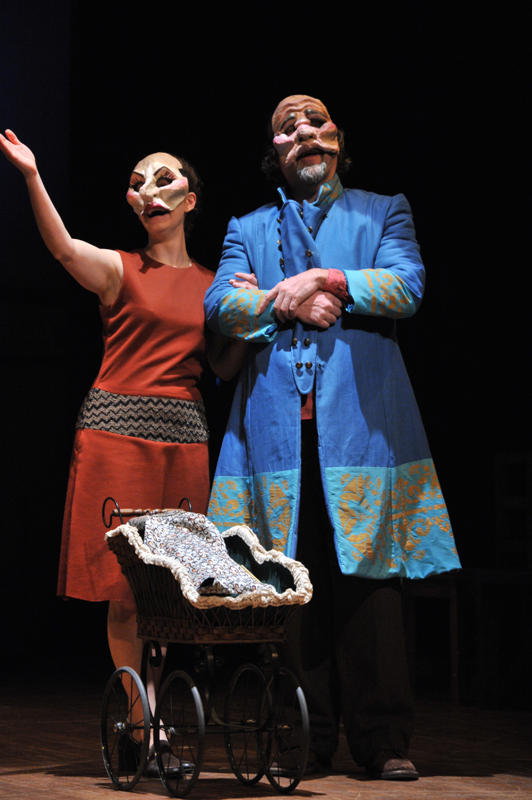
‘Elephant’ is a stunningly inventive show and the only disappointment is that its run at Greenwich Theatre is limited to five days. It’s difficult to come up with a simple word that sums up its style as it combines dance, theatre, puppetry, music, Commedia dell’Arte and ritual in a joyous telling of the life story of an African chief This collage of styles and images is amazingly coherent, and thoroughly engrossing.
The production is a hybrid of South African and European influences. This can be most clearly seen in the contrasting performances by Pady O’Connor, as the Devil, and by Zamuxolo Mgoduka as the Chief’s Brother. O’Connor has the physicality of the Devil himself, hissing and sliding his way around the words and the stage, incorporating into his performance a very European style of physical expression. The Devil has all the best lines and he brilliantly uses his hat to emphasise his words and create an extension of his own slippery personality. Contrasting with this, Mgoduka’s movement and speech is rooted in South African dance and language, he often slips into a regional language. The powerfully physical nature of his performance, his feet constantly pounding the earth, emphasise his connection with the land and his ancestors.
The show is supported by exciting music played by a single musician, occasionally enhanced by the cast when the score demands it. An array of percussion instruments provide haunting echoes of the African plains during the darkest and most moving scenes, whilst drumming and singing drive forward the dance sequences with huge energy and enthusiasm.
When the elephants (and it’s no secret that they appear in the play) lumber onto stage the audience has its breath taken away. ‘War Horse’ hasn’t got a monopoly on stunning puppets from South Africa, and for sheer impact the elephants knock Joey the horse and his friends into a cocked hat. They are impressive not only because of their extraordinary visual presence and beautiful movement – the mother elephant taking the baby one under her trunk for protection is a highly emotionally charged moment – but also because they are lit so wonderfully. Sometimes they appear as in a dream behind a gauze, and at other times in shafts of light that mimic the shade of trees in the African bush.
Whilst the play has a strong and compelling narrative, containing many comic and emotional moments, there is a very forceful message. The colonisation of Africa, as visualized by two actors in ragged uniforms selling guns to the tribesmen, is at the root of the modern disjoint conflict between man and nature. It is, ultimately, the reason why at the start of the story our narrator, Chief Zanenvula, cannot take his rightful place in heaven.
This show has been created with real love, and every member of the ensemble contributes to a highly successful evening. Even the programme, rich with photographs and text, is the best value I’ve come across for some time. If it were the West End it would be a souvenir edition sold for £10; here it’s a modest £3. The collaboration between South Africa’s Market Theatre and Newcastle’s Dodgy Clutch Theatre Company is enormously rewarding. The show has, in different guises, been on tour for around ten years and if you haven’t had a chance to see it at Greenwich my guess is that it will be at another venue near us soon.
Theatre Review: Alfie, Greenwich Theatre
May 13, 2010 by Peter Jolly

On the face of it I can’t think why anybody would like to hang around with Alfie – he’s selfish, aggressive and thoughtless. Yet, he also has the disarming innocence of a talkative adolescent, and that is a combination that has charmed audiences on radio, film and stage for a couple of generations. However much it’s against your better judgement, it’s worth spending time with Alfie while he’s at Greenwich Theatre.
The 60’s setting of Bill Naughton’s play roots the action in an era when the world was beginning to talk openly about sex and violence – the play marks a coming of age, not just for Alfie but for British society. During his voyage of self-discovery Alfie’s character appeals because he’s uncomfortably like us, an Everyman, constantly surprised by life and forced to shift his moral compass in the face of events.
A small cast of five highly talented performers confidently weave their way through Alfie’s sequence of sexual conquests, leaving in their wake a series of abandoned and hopeless figures. While the females are at the heart of the story, Ben Harrison and Courtney Spence create fine characters that convey the general hopelessness of the male of the species – all seeking the unfulfilled dream of happy partnerships. Gabrielle Meadows and Lisa Howard have the most difficult jobs, skilfully creating the widest range of comic and alluring female characters at, literally, the drop of a hat.
Sex is integral to Alfie’s character and director Adrian McDougall plays this theme well. We don’t have any steamy scenes or titillation on stage, but we do have thoroughly prosaic sex in bedsits, flats and the front of cars. This reinforces Alfie’s ordinariness and sets up the inevitable consequence of his action, an emotionally gruelling abortion scene towards the end of the play. It’s difficult to see any hope for the women who Alfie casts off like abandoned lacy knickers. The play does emphasise that fun must be paid for one way or another – and that’s a pretty depressing thought.
This seriousness is offset by a huge amount of comedy, from the cameo interval performance by the tea lady running the transport café to the inventive use of the band to create sound effects. Alfie too makes people laugh, and Edward Elk’s performance is central to the success of the evening. He has some pretty big shoes to fill, following Michael Caine and Jude Law, but Elks tightens the laces and makes those shoes do the walking. Inevitably Elks echoes his screen predecessors, both in speech and looks, but he never mimics them and he is able to strike up an intimacy with the audience with complete conviction. When he takes us back to ‘my place’ it is clear that we have become friends, and this sense of trust is thoroughly engaging. Elk’s Alfie is warm and honest; he thrives by living on a knife edge between comedy and tragedy.
‘Take me as I am, or not at all’ is one of Alfie’s mantras. I should allow him to take you into his confidence for the duration of the play – but with the proviso that he stays on stage and leaves you in your seat, lest you become a conquest too.
Theatre Review: The Cherry Orchard, Greenwich Playhouse
April 7, 2010 by Peter Jolly
A small theatre space (and Greenwich Playhouse is truly tiny) has the effect of placing actors under intense scrutiny. Sometimes that enables the audience to understand and clarify the detail, and sometimes it means you can’t see the cherry orchard for the trees. Galleon Theatre’s production of Chekhov’s play at the Greenwich Playhouse falls into the latter category. There are some good performances that explore Chekhov’s characters, and there are moments when the power of the language and imagery are vivid – but some larger flaws in Bruce Jamieson’s production overshadow these positives.
Chekhov’s play is as much about what happens off stage as what we see on stage, almost all the exciting dramatic action is reported, for instance the auction and the ball. This pays off when, for instance, Ranyevskaia (played by Maggie Daniels) movingly describes her child’s death in the river on the estate. However, the wider context of the play, the collapse of the Russian ruling class and an underlying economic and social malaise, is less clearly defined and this production fails to explore its wider significance.
The cherry orchard is itself a symbol of departed innocence and of the looming threat of urbanisation as it is cut down to provide housing. The symbolic elements of the production are successfully contained within the set – cherry blossom petals are strewn like confetti at the start of the play, and dustsheets shroud the set at the end. The romantic piano music, however, threatens to drown the play’s edge along with the actors’ voices.
Amongst some strong performances the love pairings are particularly well played – Robert Paul’s repressed entrepreneurial Lopakhin is an excellent foil to Suzanne Goldberg’s acerbic Varia. So too Nik Drake’s enthused proletariat idealist seems a fitting partner for Clare McMahon’s bouncy, playful and wide-eyed Ania. Their general sense of hope, rightly, contrasts with the pitiful denial and ‘fear of being alone’ that haunts their elders.
This production never successfully gets to grips with the parasitical group of hangers-on created by Chekhov to pick over the corpse of a dying lifestyle. It’s difficult believe with any conviction in the intensity of the subtext that should be bubbling under the surface. There are some curious directorial choices that make this assembly of characters an improbable group – I would have them nowhere near my own imaginary cherry orchard – in particular an oddly corseted Charlotta seemed to drift in and out of the action for no particular purpose. On the whole there is indeed, too much drifting.
I feel a real party pooper criticising a production that marks Galleon Theatre’s 20th anniversary and Chekhov’s 150th, but The Cherry Orchard never achieves the ambitious standards that the company sets for itself.
Theatre Review: The Duchess of Malfi, Greenwich Theatre
March 31, 2010 by Peter Jolly
There’s some pretty impressive lurking going on at Greenwich Theatre. The Duchess of Malfi shouldn’t be all about hiding in shadows but if you don’t get enough of it in a Jacobean revenge tragedy you can feel shortchanged. It is clear that the cast and the audience very much enjoyed the lurk-level in Elizabeth Freestone’s interpretation.
After all the shifty action in the windows and the doors, there’s no way round confronting the bloody nature of the play head on. Knifing, incest, mutilation, infanticide, regicide, strangulation, and torture are its currency or even, dare I say it, its lifeblood. Since we have turned up to see the play we might as well enjoy its violence, and for the greater part of the evening this worked well. Pools of blood and stained blankets effectively implied the horror without too many full on Tarantino moments; the lady in front of me barely had her hand from in front of her eyes during the second half.

So, aside from the lurking, what’s it all about and what line has this production taken? I found that a little hard to define and, although the production is an enjoyable gallop through a gory story, I feel that play has more to offer than that.
I wasn’t convinced by the decision to set the play in what I took to be the 1930’s against the gathering clouds of war. The Duchess’s powerful cardinal brother sheds his cassock for a Fuhrer’s uniform and suddenly we are in World War II. The only scene that I thought was illuminated by this setting was when Antonio, the Duchess and their family cross the stage like refugees fleeing from the ruins of their former lives. This image was certainly poignant and made the subsequent murders all the more shocking.
There are a couple of really fine performances that get to the heart of Webster’s theatricality. Tim Treloar as Bosola is a truly evil presence making the pulse beat faster; even when he repents it is difficult for us to find any sympathy. Aislin McGuckin’s Duchess is a commanding presence at the emotional centre of the production, finely moving from love to ruin whilst retaining a perfectly believable poise and integrity.
The imagery in Webster’s play is surprisingly modern and effective, sideswipes at corrupt politician and duplicitous Catholic prelates are hard hitting and have powerful resonances for our age, and possibly for all time. Elizabeth Freestone is greatly skilled at creating images that keep the audience on its toes, and none more so than the startling opening sequence in which we are left to watch the members of the cast slowly breathe their way through a minute’s silence. However, despite the visual strength, the violence and the well-told story, nagging at the back of my mind throughout was a feeling that the production didn’t really make sense of the action; I needed a firmer guide through the comings and goings.
The designer, Neil Irish, has used the space with complete assurance and it’s a real pleasure to see that he has made the fabric of Greenwich Theatre breath again. StageOnScreen’s production, specifically designed for the theatre, confirms that the building can be much more than a tour venue; we really do have a jewel on our doorstep.
Theatre Review: Volpone, Greenwich Theatre
March 29, 2010 by Peter Jolly

One of Greenwich Theatre’s highlights last year was its collaboration with Stage on Screen resulting in productions of Dr Faustus and The School for Scandal. These plays won national critical claim, transferred to DVD and are, by all accounts, selling well to schools throughout the country. The productions marked a welcome return to producing by our theatre and 2009’s Dr Faustus was unashamedly local, using a set and props that looked as though they’d been borrowed from the Royal Observatory for the purpose. Even the DVD of the production began with a high-speed trip down the Thames taking in local sights before arriving at Greenwich Theatre.
Ben Jonson’s Volpone, which opens this week, is the new joint project and will be joined by Webster’s The Duchess of Malfi. To some extent Volpone is a parable for our times, a comic story of greed, covetousness and feathering one’s own nest – the director might have had Canary Wharf in her sights as she travelled to Greenwich. However, the moral of the tale is wider than this and applies to get-rich-quick schemes throughout the ages. For his audience Jonson ironically, and successfully, seeks to mix ‘profit with your pleasure’.
The arcaded walls and tiled floor root the play in Venice, while smoke billows ominously around the theatre. There is a sense of spaciousness, created by designer Neil Irish, that is appropriate to large Venetian piazzas and palazzos. It is a world inhabited by humans who exhibit almost every deadly sin, most notably greed and lechery. Jonson, and the production, successfully unsettle the audience by creating drama in that most awkward area, between high comedy and brutal violence. Often the play is hilarious, but that only highlights the brutality of deception and rape.
The play’s success can be measured by the comic relationship between the double act at the centre of the action. In this production we find an almost perfect pairing, Richard Bremmer’s spidery Volpone disgusts and amuses in equal measure and is served brilliantly by Mark Hadfield’s energetic and crumpled fixer, Mosca (aka the parasite). Amongst the excellent cast I would highlight James Wallace’s creation of a hugely endearing character, Sir Politic Would-be. His sunburnt features and panda eyes parody perfectly the Englishman abroad. His character seems to pay homage to the late Iain Carmichael as the audience’s sympathy is aroused by his truly pathetic attempts to be an entrepreneur.
Director Elizabeth Freestone has created a hugely imaginative world in which she can slow time down, speed it up and rewind it in order to manipulate the characters for the audience’s greater enjoyment, the action after the interval being a particular treat. The costumes are wonderfully absurd creations, touched with slightly cartoon-like features, for instance stiff curled tailcoats and absurd feathers. The only element which worried me was the role of Volpone’s colourful array of companions, including a rather tall dwarf, and an unmusical castrate. Although these are Jonson’s comic clowns, in this production, they were less funny and more uncertain than one might expect.
The introduction in the programme suggests that an aim is to ‘restore Greenwich Theatre to its position as one of London’s significant producing theatres’. On this evidence it has returned and now needs to consolidate its success – perhaps with Volpone’s sister production The Duchess of Malfi?
Volpone at Greenwich Theatre running until April 10th